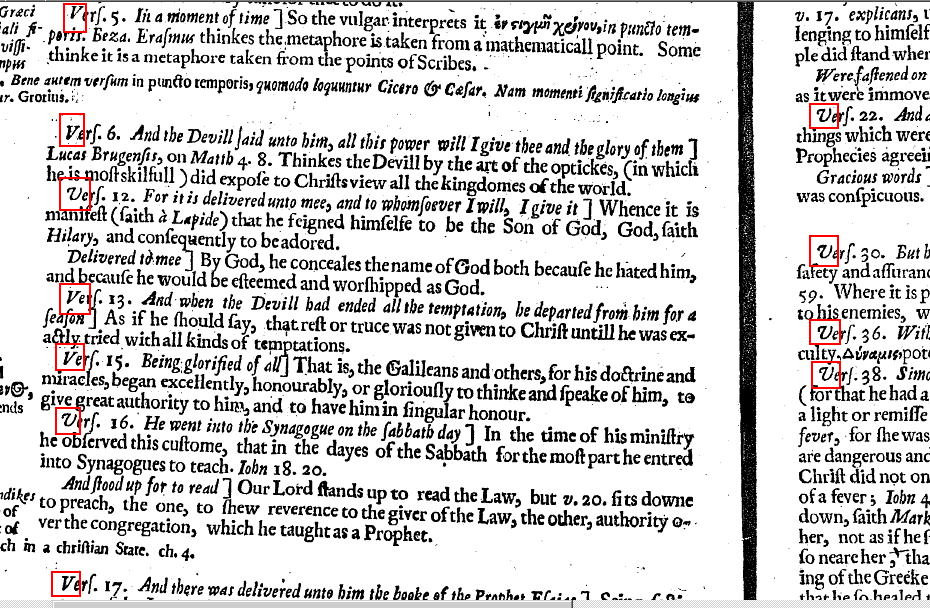
There are at least three distinct glyphs for u/v that may be used interchangeably on the same page: call them the round form, the pointed form, and the sprawling (or ambiguous) form:
I would be inclined to distinguish these by capturing the round form as 'u' and the pointed form as 'v,' if it were not for the sprawling ambiguous form. More examples:
| round (u) [capture as u] | pointed (v) [capture as v] | ambiguous (u/v) [capture as v??] |
|---|---|---|
 |
 |
 |
 |
||
 |
||
 |
The distribution of the forms seems more aesthetic or convenient than phonological (round medially; sharp and ambiguous initially), which better fits with modern 'v' than 'u'. I am inclined, on current evidence, to treat the ambiguous form as belonging to 'v.'
Uppercase italic U and V can be very confusing, and seem sometimes to have confused the printers too. There are certainly:
 ;
; .
.
And this is what seems to be an the most common form of uppercase italic U:
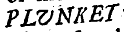
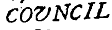
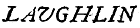
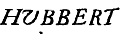
This particular book includes a clear, pointed italic uppercase V, so the difference between it and the v-like U is easy to see, even when the two letters are not distributed entirely according to modern usage.
| Pointed form (V) as consonant | Ambiguous form as vowel (U) | Ambiguous form as consonant (V) |
|---|---|---|
| [capture as V] | [capture as U?] | [capture as U?] |
 |
|
 |
 |
 |
 |
 |
 |
 |
 |
 |
|
 |
 |
|
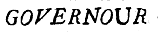
| Note that "GOVERNOUR" substitutes a roman (non-italic) 'U' in '-OUR'; I think we should treat this as a substitution (not a typo) and capture as if it were an italic U | 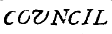 |
|
 |
||
 |
||
 |
||
 |
||
 |
||
 |
It's possible, of course, that this analysis is wrong, and that the 'V-like U' is not really a 'U' at all, or that the 'ambiguous v' is not really a 'v' at all-- or that both are genuinely ambiguous forms--i.e. forms that cannot be assigned to the modern categories of "v/V" or "u/U". Certainly the uppercase ambiguous character seems in some books to alternate freely with the pointed or angular "V", as in this book: